
Kambria DAOs
Service Revenue Sharing Contract
1. Overview
The Service Revenue Sharing Contract enables a DAO to:
- Collect service revenue on-chain
- Record payments transparently
- Allocate revenue between stakeholder groups
- Distribute revenue automatically via smart contract
- Allow beneficiaries to claim revenue directly
This module is designed for DAOs that generate recurring or transactional revenue, such as subscription services, service packages, or marketplace activities.
Revenue can be distributed to:
- LP Holders (Liquidity Providers holding DAO LP tokens)
- Order Handlers (contributors supporting sales and service execution)
2. Business Logic
The Service Revenue Sharing mechanism operates as follows:
A DAO provides services and collects service fees from users.
Users pay using predefined supported tokens.
Each payment is recorded on-chain via the smart contract.
Revenue is periodically calculated.
Withdrawable allocations are computed for:
- LP Holders (based on LP ownership ratio)
- Order Handlers (based on supported orders)
Eligible wallets claim their revenue directly from the contract.
All revenue calculations are recorded on-chain for transparency.
3. Contract Architecture
The module consists of two smart contracts:
- ServiceRevenueSharing
- RevenueCalculator
The RevenueCalculator contract handles token conversion and distribution calculations.
4. Deployment Parameters
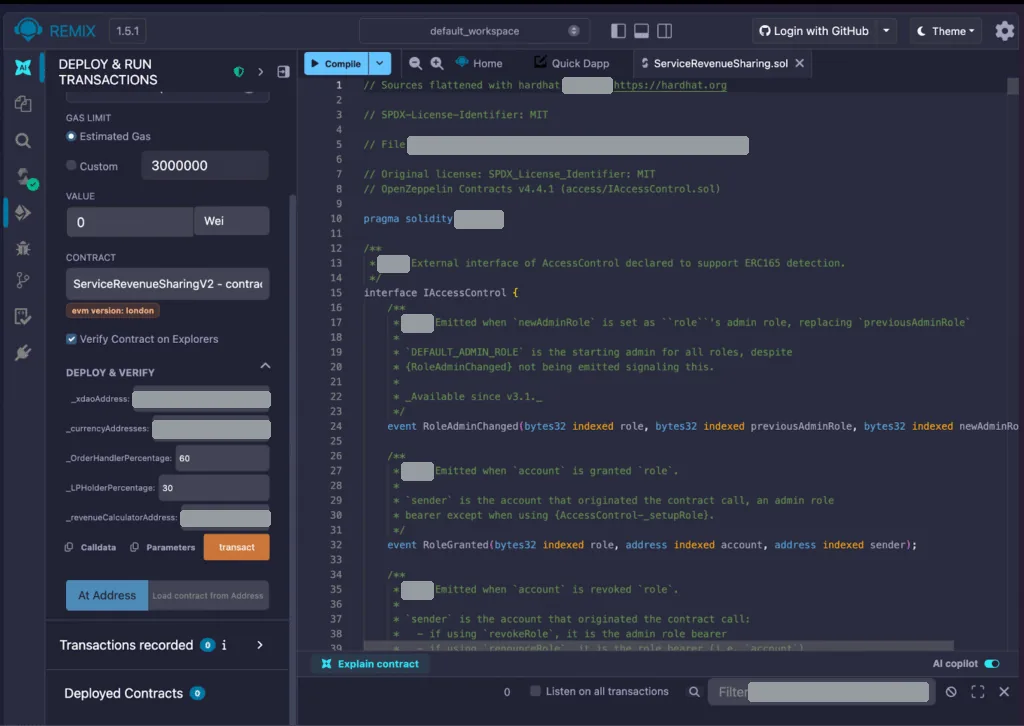
When deploying the Service Revenue Sharing contract, the following parameters must be provided:
xdaoAddress
The DAO’s XDAO contract address.
currencyAddresses
An array of supported token addresses accepted for service payments.
orderHandlerPercentage
The percentage of total revenue allocated to Order Handlers.
LPHolderPercentage
The percentage of total revenue allocated to LP Holders.
revenueCalculatorAddress
The address of the deployed RevenueCalculator contract.
Important constraint:
orderHandlerPercentage + LPHolderPercentage must be less than 100%.
5. Core Smart Contract Functions
5.1 Buy Subscription Function
Purpose: Records service revenue when a user purchases a DAO service.
Behavior:
- Payment is transferred directly to the DAO treasury.
- Revenue is recorded in the smart contract.
- Transaction data remains on-chain for auditability.
5.2 Calculate Revenue Share Function
Purpose: Calculates withdrawable revenue for each LP Holder and Order Handler.
The calculation considers:
- Total revenue collected
- Token conversion rates
- LP balances and total LP supply
- Order-handler mappings
- Predefined revenue percentages
Simplified calculation flow:
- Convert all token revenues into base token (e.g., USDT equivalent).
- Compute revenue pool for LP Holders.
- Compute revenue pool for Order Handlers.
- Allocate revenue proportionally.
- Determine withdrawable amounts per token based on DAO treasury composition.
All calculations are stored on-chain.
5.3 Claim Function
Purpose: Allows LP Holders and Order Handlers to claim allocated revenue.
Process:
- Connect wallet.
- Call claim function.
- Confirm transaction.
- Revenue is transferred to wallet.
Claim events are recorded on-chain.
6. DAO Role Workflows
This section focuses only on DAO roles (no internal admin flows).
6.1 DAO Organizer Workflow
The DAO Organizer (or authorized executor) is responsible for:
- Deploying the contract
- Adding the contract to DAO permitted list
- Configuring supported currencies
- Configuring Order Handler addresses
- Executing revenue calculation periodically
Monthly revenue process:
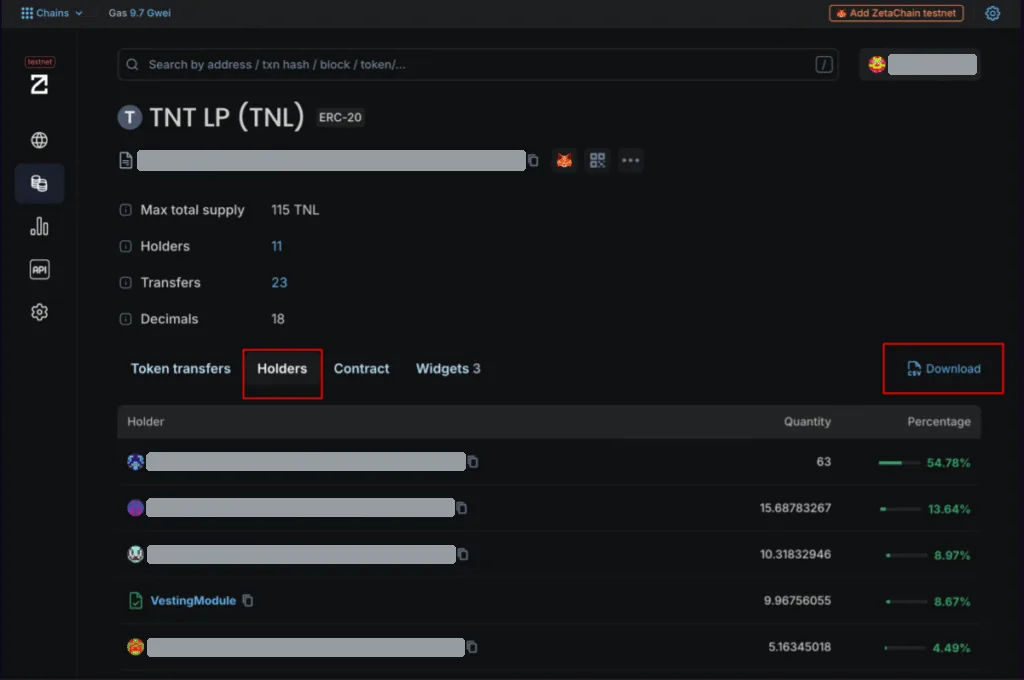
- Retrieve LP holder list from chain explorer.
- Upload LP list to DAO interface.
- Input token exchange rates.
- Execute “Calculate Revenue Share”.
- Confirm transaction.
6.2 LP Holder Workflow
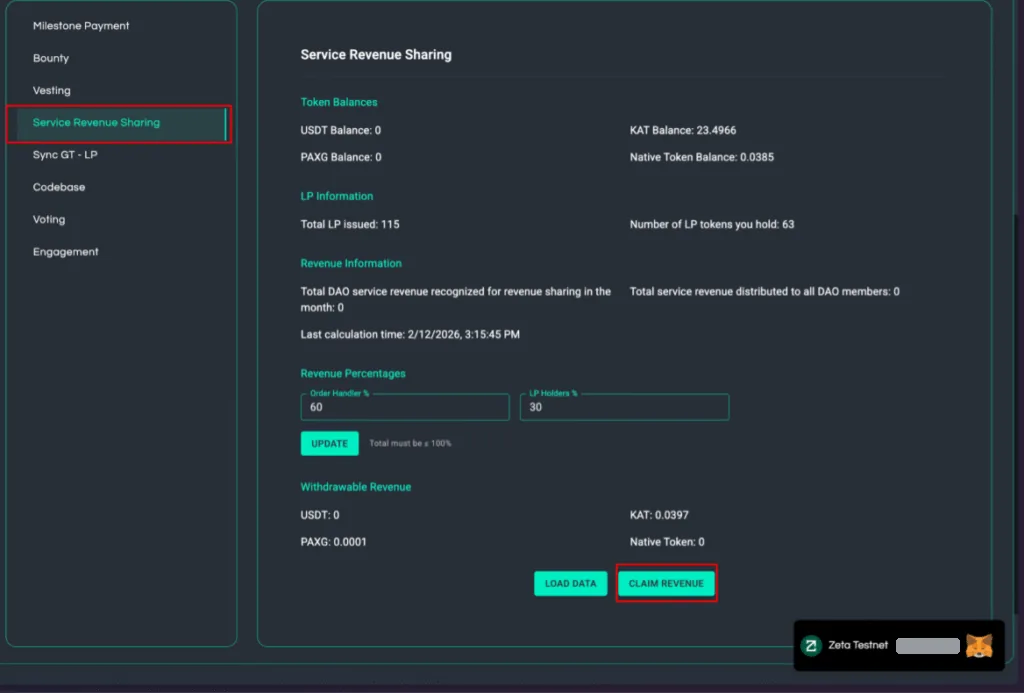
- Connect wallet to Kambria platform.
- Navigate to selected DAO.
- Open Service Revenue Sharing tab.
- Click Claim Revenue.
- Confirm transaction.
Revenue is transferred directly to the connected wallet.
6.3 Order Handler Workflow
Order Handlers:
- Are pre-approved addresses configured by DAO.
- Earn revenue percentage based on supported orders.
- Claim revenue via the same interface as LP Holders.
7. Revenue Conversion Model
To ensure fair multi-token distribution:
- All revenue is normalized to a base token (e.g., USDT).
- DAO treasury token composition is considered.
- Withdrawable amounts are distributed proportionally.
Example:
If DAO treasury holds:
- 60% USDT
- 40% KAT
Then LP allocation is distributed:
- 60% in USDT
- 40% in KAT
Exchange rates are provided during revenue calculation execution.
8. Governance and Permissions
The Service Revenue Sharing contract:
- Must be added to the DAO permitted contract list.
- Operates under DAO governance framework.
- Should transfer ownership from deploy wallet to DAO-controlled address.
- Does not custody funds outside the DAO treasury.
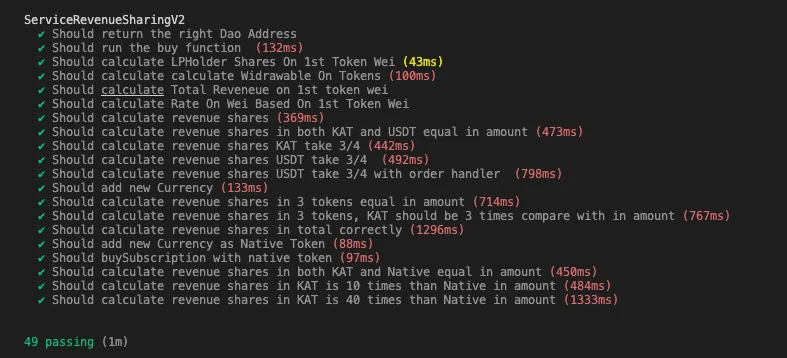
9. Testing
The module has been tested via:
- Unit testing
- Manual testing
- Multi-token scenarios
- Revenue distribution edge cases
10. Design Intent
This contract demonstrates:
- Transparent on-chain revenue tracking
- Automated distribution logic
- Incentive alignment between LP holders and contributors
- DAO-native monetization infrastructure
It forms a core component of Kambria DAOs’ product and service monetization framework.